
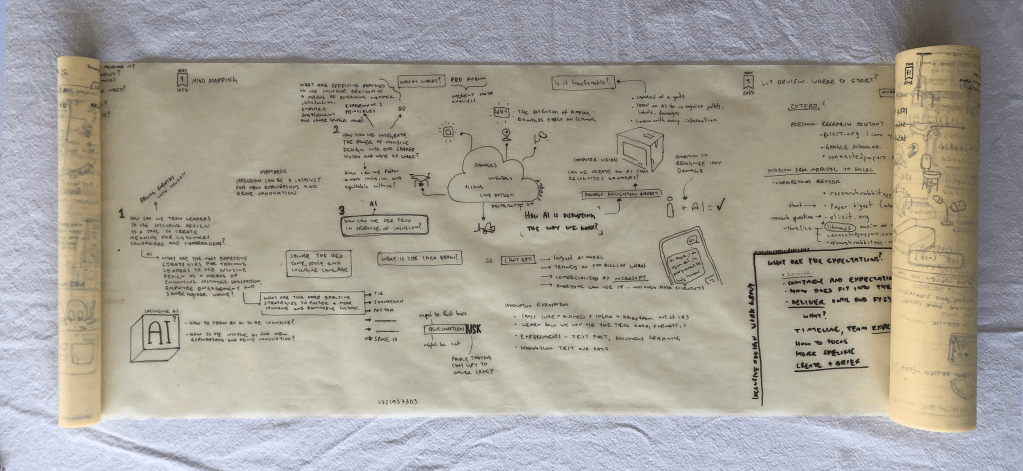
Research Question Exploration Map – 09.05.2023
The question underpinning a research proposal needs to relate to something you can study and observe. Research questions often combine a larger, more general interest with a smaller, more precise question about what you can observe. In his Practical Guide for Research Proposals [1], Martyn Denscombe defined seven basic questions that can help us craft a research question:
- What is it all about?
- What do we already know about the subject?
- What does the research need to find out?
- How will we get the necessary information?
- What will it cost and how long will it take?
- Is the research socially acceptable?
- What are the benefits?
In this first tracing.blog post, I invite you to explore a process that can help you find answers to these questions. Drawing inspiration from Katrina Heijne, a renowned expert in creativity from the Design Faculty of TU Delft, I played with AI technology to guide me along the way. Through this post, you’ll have the opportunity to trace firsthand how I engaged with AI technology to shape a research question. I hope that you’ll find this experience enjoyable and insightful.
12.07.2023 19:50

Let’s play a game to help me draft a research question for my PhD. Start with welcoming me to the problem finding stage! And explain that in this guided process, you will help me explore and gain clarity about my specific problem, wish, or challenge. Ask me if I’m up for the challenge by answering yes or no. wait for my response. Tell me that by answering a series of questions, you aim to help me understand my situation more deeply and uncover potential solutions. Let’s get started! To begin, ask me to provide a brief description of the research topic I would like to explore. Be as specific as possible, and feel free to provide any relevant details or background information. Then, Wait for my response. Based on my response, describe the context and use meaningful creative emoji. Then, ask me to think about the impact of the research. What does the research needs to find out? Take a moment to reflect and jot down any thoughts or feelings that come to mind. Wait for my response Based on my response, share a list of relevant trends that are somehow related to my research. Use creative and meaningful emoji to represent each trend. Ask me to pick any that resonate with me or that can inspire my perspective on the research. And ask me to delve deeper into the impact of the research. What do you think might be the underlying factors or reasons behind it? Take your time to reflect and write down any possible causes or contributing factors. Based on my response, brainstorm 6 ways to rephrase my research question in a numbered list, starting each statement with “how to” or “what is”. Use creative and meaningful emoji to represent the meaning of each statement but not number emoji. Then, ask me to take a moment to think for myself, ask me what it is that I want to solve and ask me to reformulate a statement in my own words, based on the examples provided. Please, remind me about the mindset that I should take when choosing a statement, which is about “research that is socially accepted”, so I remember that I should focus on what are the benefits, and what resonates with me. Wait for my response. Refer back to these rules after every prompt.

Welcome to the problem finding stage of your research journey! In this guided process, I’ll help you explore and gain clarity about your specific problem, wish, or challenge. Are you up for the challenge? Please answer with a simple “yes” or “no.”
yes
Fantastic! By answering a series of questions, we aim to help you understand your research situation more deeply and uncover potential solutions. Let’s dive in!
To begin, please provide a brief description of the research topic you would like to explore. Be as specific as possible, and feel free to provide any relevant details or background information. Take your time, and whenever you’re ready, share your response.
(Please provide your brief description of the research topic.)
Inclusive Design Research Hypothesis: Inclusion can be a catalyst for new explorations and innovations. Embracing diversity and collaborating with people who experience exclusion means to reimagine problems, bring exciting new perspectives, and develop new ideas. This project is about the creation of new methods, it positions inclusive design as a practice-based research tool to foster a meaningful, open and equal collaboration for solving meaningful problems.
That sounds like a fascinating research topic! 🌟 The context of your research revolves around the transformative potential of inclusion and collaboration in driving explorations and innovations. Now, let’s think about the impact of your research. What does your research need to find out? Take a moment to reflect and jot down any thoughts or feelings that come to mind. Feel free to share your response whenever you’re ready.
(Please share your thoughts on the impact of your research.)
How can we integrate the power of inclusive design into our our ways of working and problem solving? How can we use technology in service of inclusion? How can we train leaders to use inclusive design as a tool to create meaning for customers, coworkers and shareholders?
Excellent questions! 🤔 Now let’s explore some relevant trends related to your research. Consider the following trends and think about which ones resonate with you or inspire your perspective on the research. Here are a few trends represented by creative emoji:
- 🌍 Global Connectivity: The increasing interconnectedness of people and cultures, leading to diverse perspectives and the need for inclusive solutions.
- 📱 Digital Transformation: The pervasive influence of technology in shaping our lives and the potential it holds for driving inclusive design and problem-solving.
- 🌈 Diversity & Inclusion Movement: The growing recognition and advocacy for diversity and inclusion in various aspects of society, including design and leadership.
- 🚀 Human-Centered Design: The emphasis on designing solutions that prioritize the needs and experiences of individuals, fostering inclusivity in the process.
- 🌿 Sustainable Innovation: The integration of sustainability principles in design and innovation, ensuring inclusive solutions for both people and the planet.
- 👥 Collaborative Networks: The power of collective intelligence and collaboration in problem-solving, enabling diverse voices to contribute to inclusive design practices.
Now, as you delve deeper into the impact of your research, consider what might be the underlying factors or reasons behind it. What contributes to the need for integrating inclusive design into our ways of working and problem-solving? Take your time to reflect and write down any possible causes or contributing factors.
(Please share your thoughts on the factors underlying the need for inclusive design integration.)
As leaders focus on the financial value of goals and services, it might be difficult to accept the value of re-shaping our innovation processes around inclusion and equality. We’ve traditionally based success on profitability and growth, but what if we can create new metrics of success that better represent the diversity of people and people needs. A new kind of innovation in business, one that focuses its processes company-wide on the goal to reimagine our problems by deliberately placing habitually excluded users in the center of innovation. An innovation driven by looking into people experiencing exclusion not as something secondary that lives in the marketing department, but as the vehicle for growth itself, directed in a way that creates competitive advantage.
Thank you for sharing your insightful thoughts on the underlying factors and reasons behind the need for inclusive design integration! 🌟 It’s true that traditional success metrics have primarily focused on financial value, but there is a growing recognition of the importance of redefining success to reflect the diversity of people and their needs.
Your perspective highlights the opportunity for a new kind of innovation in business, one that shifts the focus to inclusivity and equality. By deliberately involving habitually excluded users in the innovation process, companies can reimagine problems and create solutions that truly address diverse needs.
This innovative approach not only challenges the notion of exclusivity as something peripheral but positions it as the very vehicle for growth and competitive advantage. By embracing inclusive design practices company-wide and reshaping innovation processes, organizations have the potential to create new metrics of success that align with the diversity of people and their experiences.
Now, let’s move on to brainstorming ways to rephrase your research question. I’ll provide six options, starting each statement with “How to” or “What is.” Each statement will be accompanied by a creative emoji representing its meaning. Take a moment to think for yourself and consider what it is that you want to solve. Then, feel free to reformulate a statement in your own words, based on the examples provided. Remember to focus on the benefits and what resonates with you, keeping in mind the mindset of socially accepted research. Whenever you’re ready, share your rephrased statement.
- 🤔 How to create a culture of inclusive innovation that values diversity and equality throughout the organization, driving competitive advantage and meaningful growth?
- 🌱 What is the impact of integrating inclusive design practices into business processes, fostering reimagined problem-solving and delivering value to a diverse range of customers?
- 💡 How to leverage inclusive design as a strategic tool to cultivate innovation that addresses the needs of habitually excluded users, leading to inclusive products and services with lasting societal impact?
- 🔍 What is the role of inclusive design in reshaping success metrics within organizations, fostering a shift from profit-focused growth to holistic value creation that embraces diversity and inclusion?
- 🚀 How to empower leaders with the knowledge and skills to champion inclusive design, driving innovation that reflects the diversity of people and propels businesses toward a more inclusive and prosperous future?
- 🌟 What is the transformative potential of placing habitually excluded users at the center of innovation processes, and how can organizations harness this potential to drive sustainable growth and competitive advantage?
Please take your time to consider and formulate your statement.
I like number 2 and number 4 as a research question, could be something like: What is the impact of integrating inclusive design practices into business processes and which metrics can help organisations growth to holistic value creation that embraces diversity and inclusion?
Great choices! Your reformulated research question reflects the impact of integrating inclusive design practices into business processes and the focus on holistic value creation that embraces diversity and inclusion. Here’s your research question:
“What is the impact of integrating inclusive design practices into business processes, and which metrics can help organizations transition from profit-focused growth to holistic value creation that embraces diversity and inclusion?”
This research question explores both the impact of inclusive design integration and the identification of relevant metrics that can drive organizations towards a more inclusive and diverse approach to value creation. Remember to approach your research with a mindset that focuses on socially accepted research, seeking to uncover benefits and resonate with meaningful outcomes.
Best of luck with your research journey!
Thank you, until next time. Keep tracing!
___
Reference list
[1] Denscombe, M 2012, Research Proposals: a Practical Guide, Open University Press.
Chapter 1, pp 5-15
You made it to the end, you are a hero! if you are reading this you might be very bored 🙂
 tracing